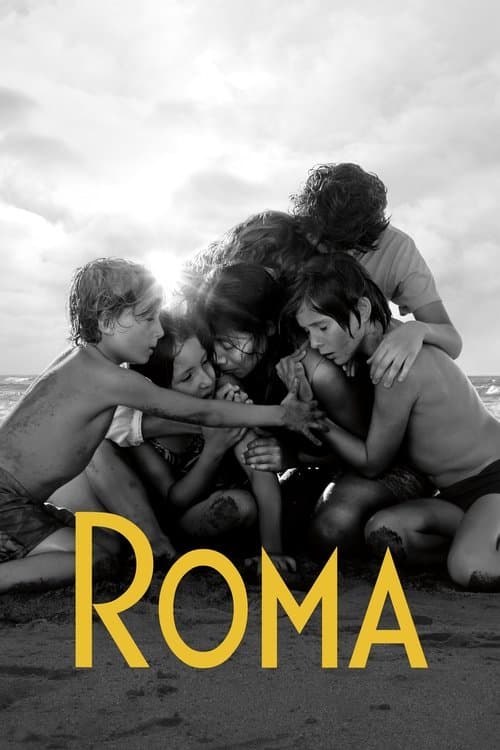
Roma
Alfonso Cuarón · 2018
Cleo, a domestic worker in 1970s Mexico City, navigates pregnancy, heartbreak, and political upheaval while caring for the family that employs her. Alfonso Cuarón's autobiographical memory film renders the invisible center of a household visible, and in doing so makes an argument about whose story gets told.
Techniques Used
5 techniques identified in this film
Black-and-White as Moral Urgency
CinematographyShooting in black and white not for nostalgia or period accuracy but as a formal argument — stripping color to force the audience to see structure, power, and moral weight that color's surface realism might obscure.
How this film uses it
Cuarón's monochrome denies the viewer easy hierarchy between the family's world and Cleo's. Without color coding social status — the family's fashionable clothing, Cleo's domestic uniform — both worlds occupy the same tonal range, the image insisting on an equality the film's social world refuses.
Non-Professional Cast Authenticity
CinematographyCasting non-actors — community members, workers, local residents — whose physical presence, behavioral specificity, and social authenticity root a film in an irreproducible social reality.
How this film uses it
Yalitza Aparicio, a kindergarten teacher with no acting experience, carries the film as Cleo. Her performance has an opacity and a stillness that professional acting cannot simulate — the camera reads her face as a text that does not explain itself, which is the film's moral position on Cleo's interior life.
Wide-Angle Observational Staging
CinematographyUsing wide-angle lenses and deep-focus staging to photograph scenes from a position of observation rather than identification — keeping the camera at a distance that implicates the viewer as witness rather than participant.
How this film uses it
Cuarón's camera pans across rooms and streets in continuous, uncut arcs rather than cutting between points of interest. The observational grammar refuses to privilege any character's perspective — the wide angle holds Cleo and the family in the same plane, the film's argument about equality made formal.
Autobiographical Distance
NarrativeA filmmaker's autobiographical material processed through a displaced or fictional protagonist — creating emotional authenticity while using narrative distance to examine the self-serving distortions of personal memory.
How this film uses it
Cuarón is the privileged child in this film, not Cleo — yet the film is centered on the domestic worker he remembers. The autobiographical distance creates a formal ethical problem the film owns: can the director accurately tell the story of someone whose interiority was invisible to the child he was?
Dialogue-Free Opening Act
NarrativeBeginning a film with an extended sequence that establishes character, world, and theme through image and ambient sound alone — proving that visual language can carry full narrative weight before a word is spoken.
How this film uses it
Roma's opening is water, tile, and reflection — Cleo's domestic labor rendered as image before she is given any dialogue. The silence establishes her world as something to be observed rather than explained, and positions the audience as observers of labor that conventionally goes unseen.
You Might Also Like
Films that share at least one technique with Roma

Filmed over twelve consecutive years with the same cast, Richard Linklater's Boyhood follows Mason Evans Jr. from age six to eighteen as he navigates family instability, adolescent confusion, and the slow formation of a self. The film's radical formal conceit — time actually passing — gives it an emotional weight no performance alone could achieve.
Boyhood
Richard Linklater · 2014

Nine-year-old Buddy experiences the beginning of the Troubles in 1969 Belfast — the sectarian violence fracturing his community — as his family debates whether to leave the only home they have ever known. Kenneth Branagh's autobiographical film is a tender, elegiac portrait of childhood on the edge of history.
Belfast
Kenneth Branagh · 2021

A Korean-American family moves to rural Arkansas in the 1980s to start a farm selling vegetables to the Korean immigrant community, and the arrival of the grandmother from Korea precipitates a crisis that tests whether the American Dream and family love can coexist. Lee Isaac Chung's autobiographical film is about what immigrant parents sacrifice for their children's futures.
Minari
Lee Isaac Chung · 2020