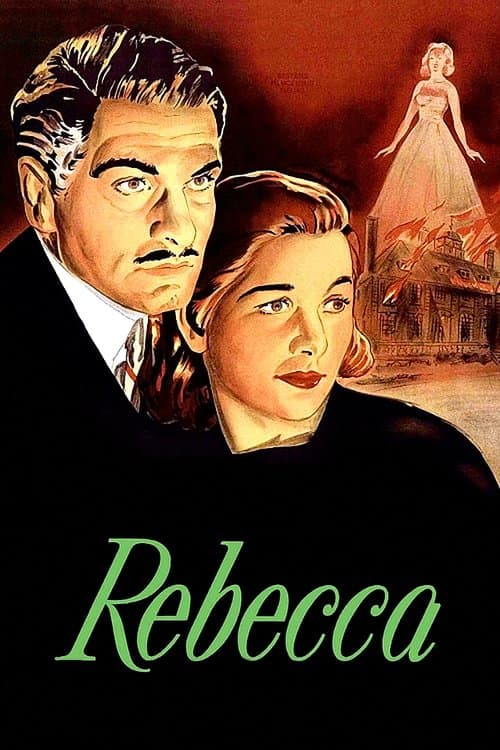
Rebecca
Alfred Hitchcock · 1940
A shy young woman marries a wealthy widower and moves into his imposing Cornwall estate — only to find herself overwhelmed by the presence of his first wife, Rebecca, who seems to inhabit every room and every relationship. Hitchcock's Hollywood debut and his only Best Picture winner.
Techniques Used
4 techniques identified in this film
Gothic Mansion Symbolism
CinematographyUsing a large, imposing house as a psychological space — its architecture externalizing the emotional and historical forces that trap its inhabitants.
How this film uses it
Manderley is not a setting but a character. Its corridors, its west wing, its Chinese room — each space is charged with Rebecca's personality, preserved by Mrs. Danvers as a shrine. The new Mrs. de Winter cannot inhabit her own home because it is already fully inhabited by a dead woman. The house is the film's primary psychological instrument.
Unreliable Narrator
NarrativeA protagonist through whose limited, anxious perspective we experience events — their account shaped by insecurity, incomplete information, and misreading — making the audience dependent on an imperfect source.
How this film uses it
The unnamed narrator misreads everything she encounters at Manderley. She interprets Maxim's moods, Mrs. Danvers's hostility, and the household's atmosphere through the lens of her own inadequacy. Hitchcock constructs the film so that the audience shares her misreadings — which is why the film's revelations require the complete reconstruction of everything preceding them.
Psychological Doubling
PsychologyTwo characters who mirror each other as shadow versions — one representing what the other secretly fears or is becoming — their relationship defining the film's psychological core.
How this film uses it
The narrator and Rebecca are shadow doubles: one alive and inadequate, one dead and perfect. The narrator cannot be herself because the role of 'Mrs. de Winter' is already occupied by a ghost. Her entire arc is about claiming an identity that has been pre-empted — discovering that the ideal she can never equal was itself a construction.
Production Design as Psychological Space
NarrativeUsing the film's production design — sets, props, décor — as a direct externalization of character psychology rather than historical or social documentation.
How this film uses it
Every element of Manderley's design is Mrs. Danvers's memorial to Rebecca — the preserved bedroom, the monogrammed linens, the specific placement of objects. The production design is not period authenticity; it is a portrait of obsessive grief arranged in three dimensions. The narrator must navigate a house that is simultaneously home and shrine.
You Might Also Like
Films that share at least one technique with Rebecca

When Amy Dunne disappears on her fifth wedding anniversary, her husband Nick becomes the prime suspect — until her diary and the investigation reveal that neither of them is the person the other believed. David Fincher's film uses the marriage thriller to dismantle the performance of gender, love, and media innocence.
Gone Girl
David Fincher · 2014

A cruel, brilliant rancher in 1925 Montana is enraged by his brother's marriage to a widow — and begins a campaign to destroy her effeminate son, until the relationship between the rancher and the boy becomes something neither man fully understands. Campion's most precise film uses the Western to dismantle its own mythology.
The Power of the Dog
Jane Campion · 2021

A faded Southern belle arrives at her sister's cramped New Orleans apartment, where the brutal truth of her situation — financial ruin, a history of desperate behavior, and the hostility of her brother-in-law — will systematically destroy the illusions she lives inside. The greatest American film about self-deception.
A Streetcar Named Desire
Elia Kazan · 1951