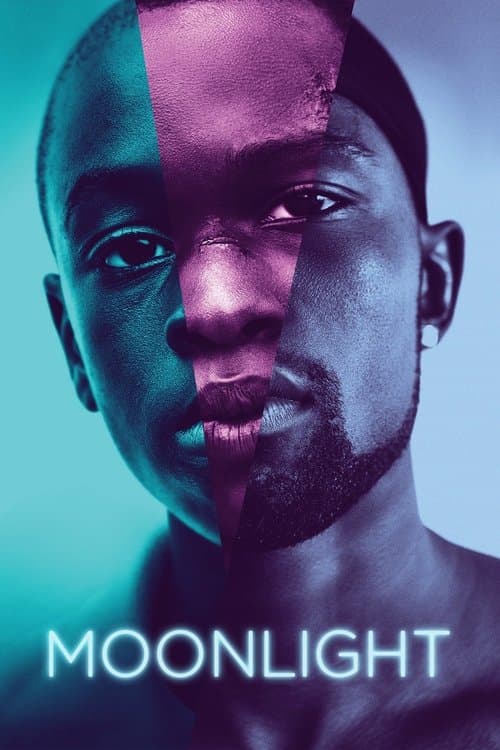
Moonlight
Barry Jenkins · 2016
A young Black man in Miami is seen at three moments in his life — as a child, as a teenager, and as an adult — each chapter revealing how he learned to hide and then forget who he actually was. A film about the cost of self-erasure.
Techniques Used
4 techniques identified in this film
Tonal Succession
NarrativeA film divided into formally distinct chapters, each with its own emotional register and visual grammar — the chapters succeeding each other rather than blending, each marking a distinct phase of the protagonist's experience.
How this film uses it
Three chapters — Little, Chiron, Black — each inhabit their own visual and tonal world. The child's chapter is blue-drenched and fluid, the camera moving with him. The teenager's is harder and more static. The adult's is almost motionless, the stillness of someone who has encased themselves in a persona. The tonal succession charts the process of self-suppression.
Color Palette as Worldbuilding
CinematographyUsing a distinctive, deliberate color palette to construct the film's world as an emotionally legible space rather than a documentary record.
How this film uses it
James Laxton's cinematography saturates the Miami Liberty City environment in blue, gold, and warm amber — the colors of skin against artificial light, of ocean at night, of a world that is simultaneously beautiful and dangerous. The palette is not realistic; it is emotional. The film's visual world is how the characters experience the environment, not how a documentary camera would record it.
Handheld Cinema Vérité
CinematographyUsing an unstabilized, mobile camera to create a sense of presence — the camera as a witness moving with characters through their world.
How this film uses it
Jenkins uses handheld in intimate scenes — the camera moving with Chiron's body, finding angles that feel discovered rather than designed. The handheld grammar says: this is being witnessed rather than presented. The intimacy is particularly acute in scenes where Chiron is most vulnerable — the camera's physical proximity a form of attention.
Earned Catharsis
PsychologyAn emotional release at a film's end that feels genuinely deserved — built through patient accumulation rather than manipulation — because the film has refused easy comfort throughout.
How this film uses it
The final scene between Chiron and Kevin — the conversation in the diner, the slow acknowledgment of what was never said — releases the film's accumulated emotion without sentimentality. Jenkins has withheld catharsis for two hours, showing only the cost of suppression. The release feels deserved because the film has been honest about what it costs to arrive there.
You Might Also Like
Films that share at least one technique with Moonlight
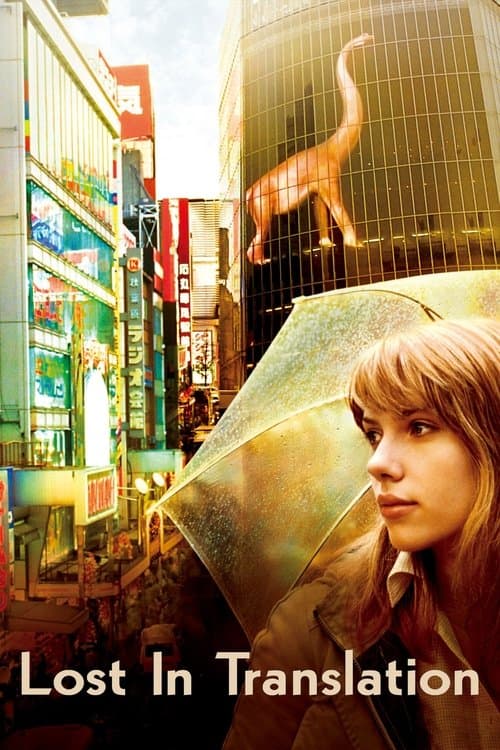
A fading American movie star and a young newlywed woman meet in a Tokyo hotel and form an unexpected connection that neither can fully name or act on. Sofia Coppola's film is about the specific texture of intimacy between strangers — the kind that only exists because it cannot last.
Lost in Translation
Sofia Coppola · 2003

Dani joins her emotionally distant boyfriend and his anthropology friends on a trip to a remote Swedish commune for a midsummer festival that reveals itself, over nine days of relentless daylight, as something ancient and murderous. Ari Aster's folk horror is also a breakup film — the commune offers Dani the grief processing her boyfriend never could.
Midsommar
Ari Aster · 2019

A young Brooklyn sex worker named Anora impulsively marries the son of a Russian oligarch after a whirlwind romance, only for the young man's parents to send fixers to have the marriage annulled and the fairy tale dismantled. Sean Baker's film is a genre-jumping portrait of a working-class woman who refuses to be simply erased.
Anora
Sean Baker · 2024