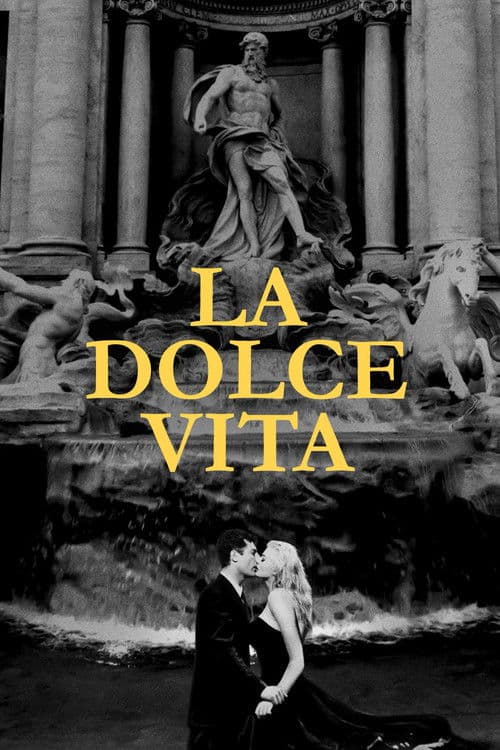
La Dolce Vita
Federico Fellini · 1960
A celebrity journalist drifts through Rome's high society over seven days and nights — parties, scandals, spiritual apparitions, beautiful women — without finding anything that satisfies. Fellini's portrait of postwar Italian society as a magnificent void.
Techniques Used
4 techniques identified in this film
Picaresque Structure
NarrativeAn episodic narrative following a protagonist through a series of encounters and environments — without a through-line of plot — the accumulation of episodes constituting the film's argument.
How this film uses it
La Dolce Vita has no plot in the conventional sense: a sequence of nights, each with its own world, its own cast, its own version of Roman excess. Marcello moves through them without development in the conventional sense. The picaresque structure means the film's argument is made through accumulation — seven days of beautiful emptiness that together constitute a portrait of emptiness.
Era-Coded Visual Grammar
CinematographyUsing the visual language specific to a historical moment — its fashion, its architecture, its social rituals — as documentary evidence of a cultural condition.
How this film uses it
The film is a visual inventory of Rome at the precise moment of its postwar transformation: the Vespas, the paparazzi, the nightclubs, the aristocratic villas, the construction cranes. Otello Martelli's photography makes 1960 Rome legible as a specific historical moment — a society between its Catholic past and its consumerist future, not yet having committed to either.
The Party as Transgression
NarrativeUsing an extended party or social gathering as the space in which social norms are suspended and transgressed — the party as a container for the film's most honest revelations about its characters.
How this film uses it
The Steiner party, the aristocratic party, the final beach party — each social gathering in the film is a space where the beautiful life reveals its emptiness. Fellini films parties as the moments when the Roman world is most itself: excessive, beautiful, and completely hollow. The party is not where the film's characters relax — it is where they are most fully exposed.
Circular Structure
NarrativeA narrative that ends by returning to its beginning — repeating an image or situation — so that the ending comments on the opening with the full weight of everything between.
How this film uses it
The film opens with a statue of Christ airlifted over Rome — spiritual authority surveilling secular excess from above. It ends on a beach, with Marcello unable to hear or understand a young girl calling to him across the water. The circular return makes the film's argument: seven days of beautiful life and Marcello can no longer hear innocence, even when it is right in front of him.
You Might Also Like
Films that share at least one technique with La Dolce Vita
Fading TV Western star Rick Dalton and his stunt double Cliff Booth navigate 1969 Hollywood as the world they built their careers on dissolves around them — and Sharon Tate lives her final golden summer next door. Tarantino's film is an act of cinematic grief and wish-fulfillment, mourning the death of one Hollywood by imagining another ending for it.
Once Upon a Time in Hollywood
Quentin Tarantino · 2019

Frank Abagnale Jr. successfully impersonates an airline pilot, a doctor, and a lawyer — and cashes millions in forged checks — before his nineteenth birthday, evading FBI agent Carl Hanratty across multiple continents. Steven Spielberg's film is about the con man as a lost boy performing the father he doesn't have.
Catch Me If You Can
Steven Spielberg · 2002
After a painful breakup, a man undergoes a procedure to erase his ex-girlfriend from his memory — but partway through, he changes his mind. A meditation on love, grief, and what makes experience worth having.
Eternal Sunshine of the Spotless Mind
Michel Gondry · 2004