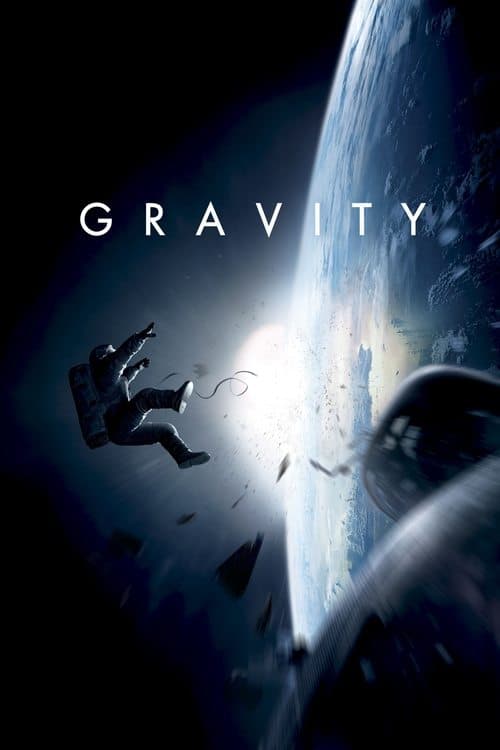
Gravity
Alfonso Cuarón · 2013
A medical engineer on her first spacewalk is stranded in orbit after debris destroys her shuttle, and must survive alone using only minimal equipment and the will to return to Earth. Alfonso Cuarón's film is a technically unprecedented survival story about the desire to live.
Techniques Used
4 techniques identified in this film
Steadicam
CinematographyA camera stabilization system allowing fluid, gliding movement through complex environments — here extended to a virtuosic long take through three-dimensional weightless space.
How this film uses it
The film opens with a seventeen-minute unbroken shot that establishes the entirety of orbital space as one continuous environment — the camera drifting between characters and through the shuttle with the weightlessness it depicts.
Single POV Restriction
NarrativeA storytelling constraint that limits the audience's information to what a single character perceives, creating intimacy and shared vulnerability.
How this film uses it
After Kowalski disappears, the film restricts almost entirely to Ryan Stone's perspective and resources — the audience knowing exactly what she knows, no more, making each problem feel as insoluble as it does to her.
Immersive Combat Sound Design
SoundA sound design approach that places the audience physically inside an environment of chaos through precise, enveloping audio.
How this film uses it
Cuarón and sound designer Skip Lievsay use the vacuum of space as a structural device — external impacts are silent while internal sounds are amplified, creating a sensory architecture that is simultaneously claustrophobic and vast.
Human Figure in Vast Landscape
CinematographyThe compositional strategy of placing a small human figure against an overwhelming environment to express existential scale and isolation.
How this film uses it
Emmanuel Lubezki's photography consistently frames Stone as a tiny figure against the infinite black of space or the curvature of Earth — the scale argument being that survival is a defiance of cosmic indifference.
You Might Also Like
Films that share at least one technique with Gravity

An idealistic FBI agent is recruited into a shadowy government task force operating in the border war against Mexican cartels — and gradually discovers that her role is to legitimize operations whose methods and goals she is deliberately kept from understanding. Denis Villeneuve's film is about the cost of a clear moral framework in a war that operates without one.
Sicario
Denis Villeneuve · 2015

A writer takes a job as winter caretaker at a remote hotel, where supernatural forces — or his own fracturing psyche — drive him toward violence against his family. Kubrick's definitive study in geometric dread.
The Shining
Stanley Kubrick · 1980

A squad of soldiers is sent behind enemy lines after D-Day to retrieve the last surviving son of a family that has lost four boys in the war. The film's opening twenty-four minutes are the most viscerally honest depiction of combat ever committed to film.
Saving Private Ryan
Steven Spielberg · 1998