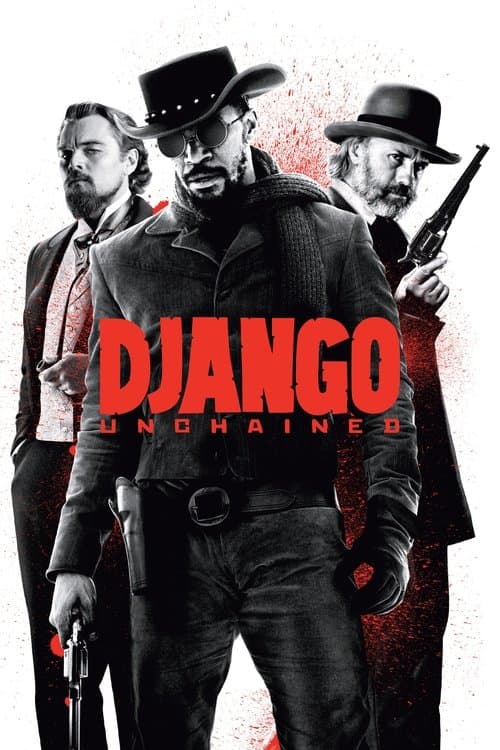
Django Unchained
Quentin Tarantino · 2012
A freed slave teams with a German bounty hunter to rescue his wife from a brutal Mississippi plantation owner. A revisionist revenge Western that uses genre catharsis to make visceral what the polite historical narrative has always made abstract.
Techniques Used
4 techniques identified in this film
Revisionist Genre Argument
NarrativeUsing a genre's conventions — its heroism, its violence, its fantasy of individual justice — to make a political argument that the genre has historically avoided, weaponizing popular form against the ideology it usually serves.
How this film uses it
Tarantino uses the Western's grammar of righteous violence — the gunslinger, the showdown, the rescue — to put a Black man at the center of a slavery revenge fantasy. The genre's cathartic violence is redirected: the pleasure the Western always produced now serves a different historical account.
Spaghetti Western Visual Citation
CinematographyDeliberately quoting the visual grammar of the Italian Western — the extreme zoom, the wide landscape composition, the close-up staredown — to invoke a tradition and position the film within it.
How this film uses it
Robert Richardson's cinematography uses Leone's techniques throughout: the slow zoom into faces during standoffs, the vast sky behind small figures, the close-up on the gun hand. Tarantino is making explicit that his film belongs to Leone's tradition, then redirecting that tradition's politics.
Anachronistic Soundtrack
SoundPlacing contemporary music — hip-hop, rock, pop — against a period setting, using the collision between the music's present-tense associations and the film's historical setting to create political and emotional commentary.
How this film uses it
Rick Ross's '100 Black Coffins' and Jim Croce's 'I Got a Name' play against the antebellum South. The anachronism is not an error — it is an argument that this history is not past, that the music's present-day associations are relevant to what is being shown.
Violence as Cathartic Argument
NarrativeStaging violence not for shock or entertainment but as a moral and political argument — the explicitness of the violence designed to make visceral what historical distance has allowed to become abstract.
How this film uses it
Tarantino stages the film's violence — the Mandingo fight, the dogs, the final shootout — at an intensity calibrated to refuse the comfortable historical distance that allows slavery to be discussed without being felt. The violence is meant to be too much, because the history was too much.
You Might Also Like
Films that share at least one technique with Django Unchained
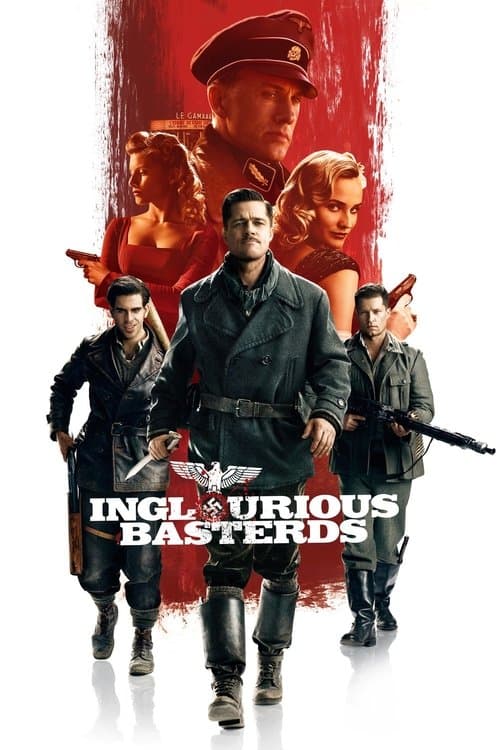
Two separate plots to assassinate Nazi leadership converge on a Paris cinema in 1944: a Jewish refugee who has rebuilt her identity and a unit of Jewish-American soldiers who scalp Nazis. Tarantino rewrites World War II as a revenge fantasy delivered through the grammar of cinema itself.
Inglourious Basterds
Quentin Tarantino · 2009
In German-occupied France, a Jewish cinema owner and a squad of American Jewish soldiers independently plot to assassinate the Nazi high command at a film premiere. Tarantino's most formally audacious film rewrites history through cinema — making the screen itself the weapon of revenge.
Inglourious Basterds
Quentin Tarantino · 2009
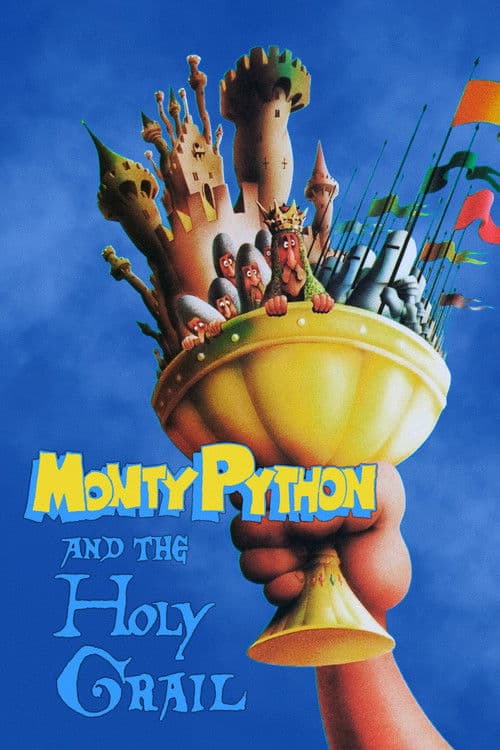
King Arthur and his Knights of the Round Table embark on a quest to find the Holy Grail, encountering a series of increasingly absurd obstacles, antagonists, and philosophical distractions. A film that destroys the chivalric epic by the most devastating possible method: taking it completely seriously.
Monty Python and the Holy Grail
Terry Gilliam, Terry Jones · 1975