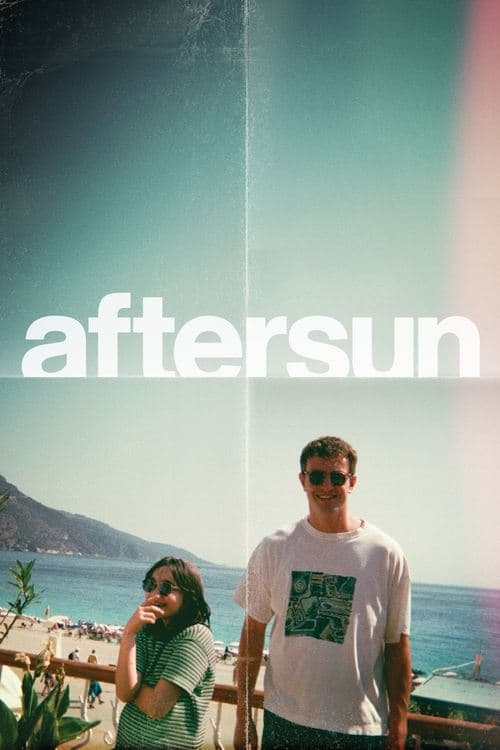
Aftersun
Charlotte Wells · 2022
A woman in her early thirties reviews footage from a holiday she took with her father when she was eleven, trying to recover something she didn't understand at the time. Wells's debut film reconstructs a past through the double lens of a child's incomplete perception and an adult's incomplete understanding.
Techniques Used
4 techniques identified in this film
Fractured Memory Editing
EditingAn editing structure that mirrors the discontinuity of memory — sequences incomplete, moments recurring, the past assembled from fragments that don't fully cohere.
How this film uses it
Wells cuts between the holiday footage that Sophie is watching, her adult perspective watching it, and fragments of experience that may be memory or imagination. The editing refuses to assemble a complete account of what happened to Calum — which is the point. Memory doesn't assemble; it accumulates fragments, and the gaps are where the film's most important content lives.
Handheld Cinema Vérité
CinematographyUsing an unstabilized, mobile camera to create the quality of something witnessed rather than staged — the camera as a present observer inside the scene.
How this film uses it
Gregory Oke shoots both the 'camcorder footage' register and the observational register with handheld work that gives both the quality of something being recorded rather than directed. The film's visual texture is the texture of memory — slightly uncertain, slightly mobile, close to things but unable to be entirely inside them.
Proleptic Opening
NarrativeBeginning at or near the film's conclusion — establishing an endpoint before the story that led there — so that the narrative becomes a retrospective explanation.
How this film uses it
The film opens with the adult Sophie already watching, already looking back. The narrative structure makes the holiday simultaneously present-tense (as we watch it) and already over (as Sophie watches it). Every happy moment is shadowed by the knowledge that Sophie is watching it from a future in which something has happened.
Observational Restraint
CinematographyA visual approach that watches at a measured distance without dramatic emphasis — the camera as a patient witness that declines to editorialize.
How this film uses it
Wells's camera watches Calum with the restraint of a child's perception: present, attentive, but without full understanding of what it is seeing. The film withholds psychological explanation and dramatic emphasis at precisely the moments when conventional filmmaking would provide them — mirroring Sophie's own incomplete access to her father's inner life.
You Might Also Like
Films that share at least one technique with Aftersun
After his brother's death, a withdrawn handyman named Lee Chandler returns to his hometown to become guardian to his teenage nephew, where he must confront the catastrophic grief that exiled him from the community. The film is a precise and devastating study of guilt that cannot be dissolved.
Manchester by the Sea
Kenneth Lonergan · 2016
An adult man named Jack remembers his 1950s Texas childhood — his gentle mother, his severe father, and the loss that divided their family — in a film that expands those memories into a twenty-minute meditation on the origin of the universe. Terrence Malick's most ambitious film asks what individual human grief means in the context of four billion years of life.
The Tree of Life
Terrence Malick · 2011
Two childhood friends in Seoul are separated when one emigrates to Canada, reconnect twice over twenty-four years — once in their twenties online, once when he visits her in New York a decade later — and must reckon with the life not lived. The most emotionally precise film about adult longing in years.
Past Lives
Celine Song · 2023